

New Delhi: Over the last few years, smart phone manufacturers and app developers have been pioneering technology that suggests a shift in the role that mobile devices play in their users’ lives.
They are now trying their way harder for re-imagining the phone as an important health tool as well as a communication device. And, the latest breakthrough in this field, by engineers at the University of California San Diego, will enable diabetes patients to monitor their glucose levels, whether they're at home or on the go.
Currently, checking blood sugar levels can be a hassle for people with diabetes, especially when they have to pack their glucose monitoring kits around with them every time they leave the house.
“Integrating blood glucose sensing into a smart phone would eliminate the need for patients to carry a separate device,” said Patrick Mercier, a professor of electrical and computer engineering at UC San Diego in a statement.
“An added benefit is the ability to autonomously store, process and send blood glucose readings from the phone to a care provider or cloud service.”
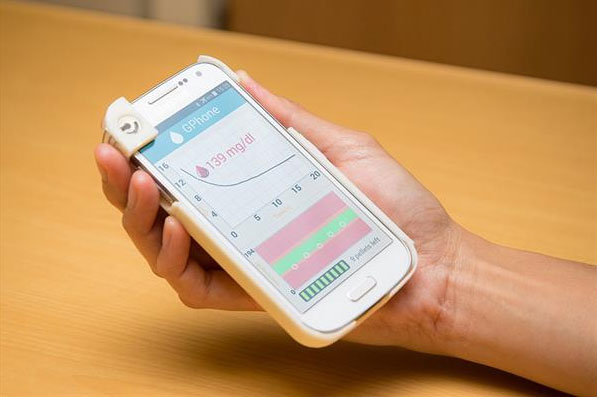
The innovative system is known as the GPhone, which has two main parts. One is a slim, 3D printed case that fits over a smartphone and has a permanent, reusable sensor on one corner. The second part consists of small, one-time use, enzyme-packed pellets that magnetically attach to the sensor. The pellets are housed inside a 3D printed stylus attached to the side of the smartphone case.
It is currently at the proof-of-concept phase. It was created by a team based at UC San Diego’s satisfyingly specific Centre for Wearable Sensors, and the details of their project were laid out in a paper entitled “Re-usable electrochemical glucose sensors integrated into a smart phone platform’’, which was published in the journal Biosensors and Bioelectronics.
The technology allows a person with diabetes to check their blood sugar levels whenever necessary, wherever they happen to be, using a few simple components and a proprietary mobile app.
A number of small, one-time use, enzyme-packed pellets contain an enzyme called glucose oxidase, which reacts with glucose. This chemical reaction generates an electrical signal that can be measured by the sensor’s electrodes, and the greater the signal is, the higher the glucose concentration. Tests with known glucose concentrations showed that the system can measure blood sugar levels to a very high degree of accuracy.
To test glucose levels, a user dispense a pellet onto the sensor, which activates it. The user then drops their blood sample on top, and the sensor measures the blood glucose concentration as explained. The data is then wirelessly transmitted, via Bluetooth, to a custom-designed Android app. This software displays the numbers simply on the smart phone screen, for the user to get an easy reading, and the whole process takes just 20 seconds.
The next steps for the project will be to test the technology on actual blood samples instead of just pre-prepared glucose concentrations, as well as minimizing sample volumes. The current prototype uses at least a dozen drops of sample per test, which is more than the finger prick normally required from a diabetes patient for this kind of DIY monitoring kit. Getting the price of the pellets down is also something that might be necessary in order to make the system commercially viable, as they are slightly more expensive than the test strips currently used.
If this project is successful, the team hopes to one day come up with a way to integrate this kind of sensing technology directly into the mobile device, without the need for a special case.
The project was supported in part by the National Institute of Biomedical Imaging and Bioengineering of the National Institutes of Health.
References:
https://www.inshorts.com
http://ucsdnews.ucsd.edu
http://www.hindustantimes.com
https://techxplore.com
http://www.3ders.org