

The ongoing Russia-Ukraine war, which has entered Day 392, has seen different types of weapons and strategies being deployed. The West, in its efforts to help, has provided Ukraine with several munitions — ranging from the Patriot missile to different types of tanks and other armaments.
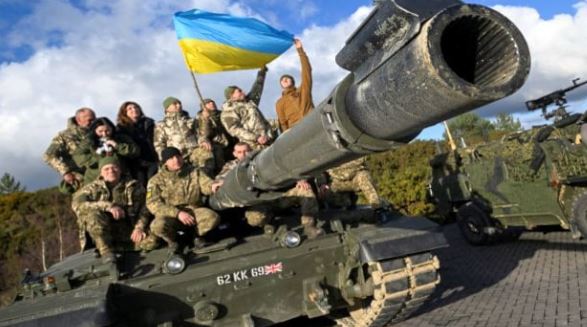
On Monday, Britain announced its plans to send Challenger 2 tanks along with ammunition, including armour piercing rounds. However, this decision has irked Russia, with Vladimir Putin telling reporters — after talks at the Kremlin with his Chinese counterpart Xi Jinping — that Moscow would be “forced to react” and accused the West of deploying weapons with a “nuclear component”.
The tank shells in question are made with depleted uranium. Britain’s Minister of State for Defence Annabel Goldie on Monday confirmed that the UK would supply “armour piercing rounds which contain depleted uranium” to Ukraine with its gift of 14 Challenger 2 tanks because they are deemed “highly effective in defeating modern tanks and armoured vehicles”.
Responding to this statement made by the British minister, Putin was quoted as saying, “If all this happens, Russian will have to respond accordingly, given that the West collectively is already beginning to use weapons with a nuclear component.”
But what exactly is depleted uranium and how is it used in weapons? How dangerous is the use of such ammunition? We take a closer look.
Depleted uranium is a by-product of the nuclear enrichment process used to make nuclear fuel or nuclear weapons. It is 40 per cent less radioactive than natural uranium, but is a very heavy substance — 1.7 times denser than lead.
Depleted uranium has a variety of applications because of its high density and its pyrophoric properties. Civilian uses for depleted uranium include counterweights in aircraft, forklifts and even sailboat keels. It is also used in medical radiotherapy as a radiation shield and until 1982 as dental porcelain crowns.
Militarily, depleted uranium is used in armour plates in heavy tanks and in armour-piercing ammunition. Defence experts state that it is used to harden rounds so that they can penetrate armour and steel. They say that when a weapon made with a depleted uranium tip or core strikes a solid object, like the side of a tank, it goes straight through it and then erupts in a burning cloud of vapour.
According to a report published by Scientific American, what makes depleted uranium deadly is that uranium shells burn away at the edges. This “self-sharpening” helps them bore into armour.
(With inputs from agencies)