

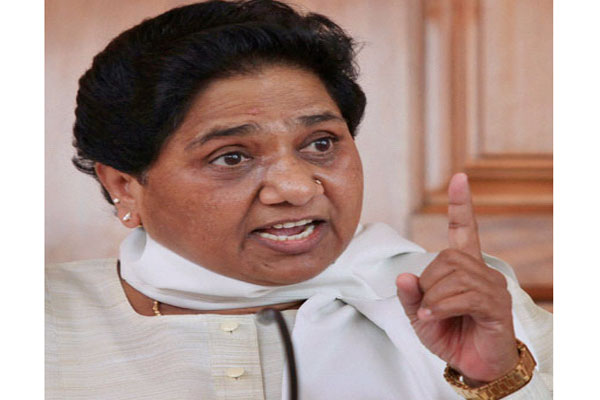
New Delhi: As the events have started to unfold, the ‘resignation’ of Bahujan Samaj Party chief Mayawati from Parliament on Tuesday, hours after storming out of the RajyaSabha over not being allowed time to complete her speech on alleged Dalit atrocities in Uttar Pradesh, may just end as a drama.
People have strongly coming to be believe that Mayawati chose to ‘resign’ to survive the political crisis she is facing. The BSP Chief is fighting the grimmest battle for survival in her nearly four decade long political career.The performance of her party in the 2017 UP elections and 2014 LokSabha elections have rung warning bells for the former UP Chief Minister.
She is anyway scheduled to retire next April from RajyaSabha and here party doesn’t have the wherewithal to get her a fresh term on its own. She is the lone member of her BSP in the entire Parliament. In Uttar Pradesh, a state she ruled four times as chief minister, she has just 19 MLAs. She can’t even enter the legislative council in Lucknow, with that strength.
Her present crisis call for a quick flashback on her rise to power. In 1993 BSP founder Kanshi Ram formed a coalition with the Samajwadi Party and a government was formed. However, the coalition broke midway and Mayawati became the youngest Chief Minister of Uttar Pradesh in 1995. She was the first female Scheduled CasteChief Minister in India. In 1997 and in 2002 she again became Chief Minister with the outside support of the BharatiyaJanata Party (BJP), the second time only for a year up to 26 August 2003 due to BJP withdrawing support.
When in 2007 the BSP came to power with 206 of 403 seats, it adopted 'SarvajanSukhaye, SarvajanHitaye' as its motto. The words meant that its government was one for everyone's welfare and everyone's interests. This was the brave new BSP sought to shed its 'image' as a party of the Dalits.It was this image makeover that had helped it capitalise on popular disenchantment over law and order with the Samajwadi Party government.
However, the 2009 LokSabha results were disappointing: She expected 60 of 80 seats in UP, but won only 19. This was partly because the Congress did well: It made voters respond to its performance at the Centre, which included things like NREGA.
The upper caste 'Sarvajan' voters did not see any reason why she should be Prime Minister.
More importantly, many Dalits did not turn up to vote, something not reflected in exit poll data. The exit poll data for 2009 did show, however, a shift from some non-Jatav voters to other parties, mainly the Congress.While Mayawati initially blamed Muslim voters for the 2009 debacle, the feedback from the party cadres must have been shattering: The drop in the number of Dalits who did not go to the polling booth was in some parts as high as 25 percent.
After May 2009, as a result, Mayawati changed the 'tone' of her government. In name it remained a Sarvajan government. But in practice, Dalits started getting what they wanted. To give this signal, she sidelined Satish Chandra Mishra, her Brahmin mascot.It wasn't symbolism alone. She did what the Dalit masses wanted: Gave their educated lot jobs, especially as assistant teachers, made the SC/ST Atrocities Act's implementation more stringent, gave small pieces of land to thousands of landless Dalits, and built them houses.
However, all this did not help. The downfall of her political career started in 2012 when she lost in the legislative assembly elections to the rival Samajwadi Party. The party has been on a downslide ever since.
Mayawati was born on January 15, 1956 in Delhi where her father Prabhudayal was employed as a supervisor with the Post and Telegraph department.The BSP president did a major part of her education in Delhi. She has come a longway from being municipal school teacher.Mayawati is now fighting for political survival.