

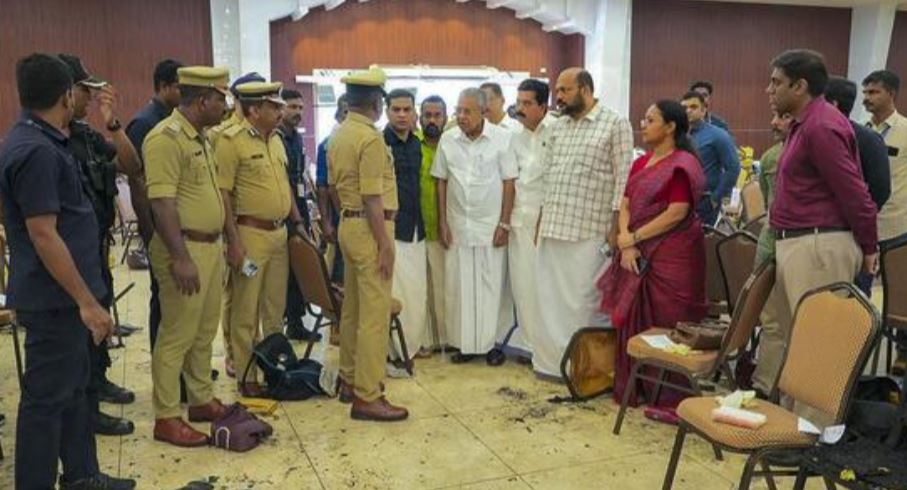
An analysis of the Kalamassery blast site in Ernakulam district of Kerala by forensic experts has revealed that Dominic Martin, the self-confessed operative, used low-grade explosive from firecrackers and around 7-8 litres of petrol to make the crude bomb, people familiar with the matter said on Monday.
A radio frequency system, in this case a mobile phone, was used to detonate the bomb, which means Martin had to be within 400-500 metres of it, they said, declining to be named. The findings have been shared with investigators of Kerala Police and National Investigation Agency (NIA).
“It was a "sutli" bomb, assembled using explosives from firecrackers and petrol to make it into an incendiary device, so that the convention centre catches fire, and the idea was to cause maximum damage. A mobile phone call worked as a radio-frequency trigger system, but the range of such devices is usually low, so Martin had to be there to make the call to complete the electric charge and trigger the IED (improvised explosive device),” said a counterterrorism official.
Three people, including a 12-year-old girl, have died so far from the blast, which took place at Zamra International Convention and Exhibition Centre at Kalamassery near Kochi around 9:30am on Sunday on the final day of a three-day zonal conference of the Jehovah’s Witnesses, a Christian collective that has a few hundred thousand followers in Kerala.
Martin surrendered to police, claiming responsibility for the bomb blast and calling the teachings of sect “anti-national and seditious”.
Martin most likely learnt to make the “sutli” bomb from the internet, which is full of videos on fabricating such crude bombs, the official said.
“Sutli” or twine bombs are popular in India during functions and festivals, and are the easiest available source of explosives. In 2018, the federal anti-terror agency unearthed a module inspired by the ISIS terror group, which had planned to make “sutli” bombs after watching videos online.
Operatives of Indian Mujahideen, a defunct terror group, had also attempted to make ‘sutli’ bombs using videos available on the internet, the officials said.
Martin is being interrogated by a team of Kerala Police as well as sleuths of the NIA to find out more about his motive in carrying out the blast. The NIA is likely to soon take over the probe as the Unlawful Activities Prevention Act has been invoked by Kerala police in its first information report. Martin’s background and associations are being verified, a second official said.
(With inputs from agencies)