

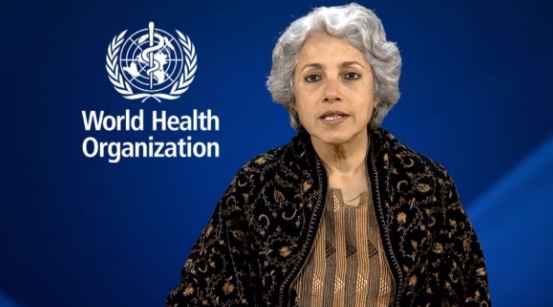
Even as India faces a second wave of Covid-19, World Health Organisation (WHO) Chief Scientist Dr Soumya Swaminathan on Monday said a prelim data has showed that Indian variant is more contagious and transmissible, adding that there is heterogeneity in the country in terms of spread of the infection. Urging people to get the vaccines, she said inoculation is important as it will reduce the severity of coronavirus.
In a exclusive interview to a news channel, Swaminathan said that the double mutation strain consists of variants found in Brazil and South Africa and it evades body’s immune response.
“Surge in India increases chances of more dangerous variants emerging. Prelim data shows that Indian variant is more contagious. There is heterogeneity in India in terms of spread of Covid-19. WHO is concerned about number of cases and deaths in India. Globally, cases and deaths have plateaued, not in South Asia. South East Asia is seeing case rise owing to India. Overall numbers hide what is going on, need to go deeper in state, local level data,” she said.
Speaking on efficacy of vaccines available in India, she assured, “There is no enough data to show that double mutant is vaccine resistant. All the available vaccines today in India and elsewhere prevent severe disease and death even if you get up the infection. You are not going to end up in the ICU critically ill. The message is take the vaccine whichever is available and you eligible for it. If your turn is there, please take it.”
This can also be seen as a clarification by Swaminathan on her previous remark in a interview with AFP, where she was quoted saying that Indian variant may be “dodging vaccine protections”, contributing to the country’s explosive outbreak.
On being asked about how soon the WHO will be able to get a data on transmission of B.1.617 variant of Covid-19, which was first detected in India last October, she said, “We have to wait for the data to come in. The WHO’s experts group is dealing with it and are in touch with Indian scientists. I believe in next couple of weeks we will have enough data both from lab and clinical epidemiological observations. WHO classifies mutant as variant of interest when a variant is becoming more prominent. Still very little clinical and epidemiological data to conclude if B.1.617 is more virulent or not. Data currently available tells us that it is more transmissible.”
“Studies show even if variants are susceptible to anti-bodies, vaccine can still reduce severity of disease. Just wanted to reassure the public that there is no such things as saying that vaccines are not working on this new variant resistant,” she reiterated.
The WHO recently listed B.1.617 — which counts several sub-lineages with slightly different mutations and characteristics — as a “variant of interest”.
“It would have been easier to compare and clear vaccines for approval by WHO if all vaccine makers had followed WHO solidarity trials procedure,” said Swaminathan, adding that not just India, many countries are dependent on COVAX struggling for Covid-19 vaccine supply. “We (WHO) are hoping to get more data on vaccines like Sputnik, Sinopharm, etc. Israel’s vaccination has shown Pfizer shot is around 90 per cent effective in the real world,” she said.
The WHO scientist also pointed out that head to head vaccine trial should have been done from the beginning. “Globally, we have 14-15 vaccines available. Fore new generation of vaccines, we are depending on solidarity vaccines trials. We will have to use real world data to understand how vaccines are performing across the world. Depending on real world effectiveness studies on effectiveness and safety.
Meanwhile, after recording over four lakh fresh cases for four consecutive days, India witnessed a single-day rise of 3,66,161 Covid-19 cases on Monday, which pushed its tally to 2,26,62,575, according to the health ministry. The death toll due to the coronavirus climbed to 2,46,116 with 3,754 more people succumbing to it, the ministry’s data updated at 8 am showed.
(With inputs from agencies)