

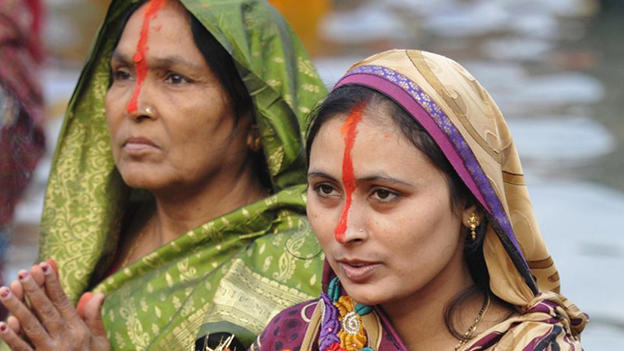
The Chhath Puja, which used to be the festival of Bihar, Uttar Pradesh and Jharkhand till recently, has off late taken over other festivities in national capital Delhi, in terms of the sheer number of participations, fervor, and enthusiasm. The mounting grandeur of the festival symbolizes the rising power exercised by the sizeable Purvanchali community – migrants from UP and Bihar in the city’s political and social landscape.
Delhi’s traditional inhabitants Punjabi Khatris, Jats and Gujjars (living mostly in urban villages) may still claim influence in the city’s politics, but over the past two decades, the lever has shifted to Purvanchali community, who have now a sway in over 30 assembly segments. Inhabiting in hundreds of unauthorized colonies, they can tilt the electoral balance.
The Purvanchalis comprising national capital workforce such as laborers, hawkers and rickshaw pullers alone, makes up roughly one-third of Delhi’s voter population. Political leaders from Aam Aadmi Party (AAP), Bharatiya Janata Party (BJP) and Congress are flocking to their localities to woo them.
A loyal voter of Congress party till 2013, Purvanchalis switched sides and extended support to Arvind Kejriwal’s AAP after Anna Hazare movement.
Till 2013, Delhi had seen a direct contest between BJP and Congress. Both of them were dependent on Delhi’s traditional voters, little realizing that Purvanchali or migrant voters have become a force to reckon with. AAP realized the potential of migrant votes, by literally accommodating Purvanchalis into its ranks. The current Delhi Assembly has 13 members representing the Purvanchal. Gopal Rai, the cabinet minister in the Kejriwal’s government and Sanjay Singh, one of the three Rajya Sabha MPs from Delhi are amongst the prominent Purvanchal faces that represent the government.
“AAP recognized and identified the numerical strength of Purvanchali, which became the game-changer for the party in the 2013 election. This also led to the beginning of a new phase for Purvanchal voters, says Professor Sanjay Kumar of the Centre for the Study of Developing Societies (CSDS).
Till 2013, both the BJP and Congress had failed to realize their electoral potential. They used them nothing but a pressure group, with no potential to influence the political dynamics of the city. Leaders like Lal Bihari Tiwari and Kirti Azad, then with the BJP and Mahabal Mishra of the Congress did emerge as representatives of Purvanchal, but did not enjoy much clout in their parties. Congress did experiment by fielding Mishra, the Purvanchali voice in Delhi, from the West Delhi constituency in 2009, over Mukesh Sharma, who had a strong base in Jat and Brahmin votes in rural Delhi. The decision paid dividends and Mishra got elected by a handsome margin.
Mishra agrees that his party at one point in time failed to recognize the potential of the Purvanchali votes. “Before the 2013 election, I had told the then Chief Minister Sheila Dikshit, that, to keep AAP out, the party must give at least 25 tickets to Purvanchali candidate. But she probably thought that I was over ambitions for Purvanchal and did not take my suggestion seriously. And we all know the result,” he said.
In that election, the Congress that had ruled Delhi for 15 years, was reduced to 8 seats as the migrant voter shifted to AAP.
Delhi saw the rush of migrants from the east during the regime of Lalu Prasad Yadav in Bihar. The complete breakdown of law and order situation, with no job opportunities, forced people to move to Delhi. “Since small towns of Bihar like Samastipur and Muzaffarpur had train connectivity to Delhi, it became the first choice for Biharis over Mumbai and Kolkata,” said political analyst and psephologist Abhay Kumar.
It was also during those times that then India’s Election Commissioner TN Seshan initiated a voter enrolment campaign. Thousands of these migrants became voters of Delhi, changing the social landscape of the city.
“Before 1990 Delhi voter comprised of forward caste and Muslims. Post 1990 it became migrants plus Muslims. Unlike upper-class Punjabi and Baniyas, both migrants and Muslims get actively involved in the politics of the day,” Abhay Kumar added.
After Purvanchalis it is the Muslim that forms an influential chunk of the Delhi voters. Unlike Purvanchal votes that are distributed across 30 of the 70 assembly seats. This 12 percent of Muslim votes is confined to a handful of constituencies. Besides Muslims, Punjabis make up 11 percent votes, Baniyas about 6 percent, Sikhs and Jats 4 percent of the 1.40 crores vote of Delhi.”
Most of the Purvanchali migrants settled in areas that comprised of unauthorized colonies of Delhi. Amending Delhi’s Master Plan in 2001, allowing development work in these unauthorized colonies was an effort of some Purvanchali leaders. “The move not only provided better living conditions in these colonies but also saw an overnight increase in property prices in these areas. Money began to flow amongst the migrants,” adds Mishra, who was then a Member of Parliament from Delhi and played a key role in getting the plan amended.
A decade later, BJP too is banking on its Purvanchali state chief Manoj Tiwari to garner migrant votes. Tiwari defeated three times Delhi Chief Minister late Sheila Dikshit from North East Delhi in the 2019 Lok Sabha election. The party is hoping that the Bhojpuri singer, this time too, will bring back these votes to the BJP pool.
“Twenty years ago, nobody would have imagined that a Purvanchali could head a party like BJP in Delhi,” adds Sanjay Kumar.
BJP’s Rajya Sabha MP Vijay Goel in 2014 had called the Purvanchali migrants a burden on the city’s growth. Goel had then said that every year about six lakh Purvanchalis migrate to Delhi and they stall development work of the city. He had then said that this migration from Purvanchal should be stopped.
However in 2018 while addressing BJP’s booth level workers in east Delhi he tried to strike a chord with them. “Jab tak Vijay bhaiya ba, kauno ke majaal naikhe ki Purvanchal ke bhai logan ke baal bhi banka kar sake. (As long as Vijay Bhaiya is there, nobody in Delhi could dare cause even a little harm to Purvanchali in Delhi,” he had said,
Incidentally, Congress that had to recognize the potential of this Purvanchal base in the 1990s has missed the plot yet again in its infight between Baniya- Punjabi- Purvanchal leaders.
Mishra who had been the pioneer in steering Purvanchali votes is a man out of action for now. While other parties are trying to make the best use of their Purvanchal leaders, Mishra, a man of all seasons has been kept out of the fray. Instead, the party has picked up Kirti Azad who has switched over from the BJP to lead its campaign committee.
Mishra is credited for providing identity and recognition to the Purvanchal population in Delhi. He to his credit also has the establishing of Maithili- Bhojpuri Academy under Delhi government. For over a decade he continued to be the voice of Purvanchal both in the corridors of power and on the streets of Delhi often leading demonstrations against its party.
But in this election season, where the Congress party is battling to conquer its lost ground, Mishra has a little role to play. He is also missing out on the party posters in west Delhi, his political bastion.
“I have led the struggle for Purvanchal cause from the time, word Purvanchali was used as a slang. The Purvanchali youth today does not know about the struggles of their parents and the grandparents,” says Mishra. “It is better to leave some stories for the time to tell,” he said.
Though sidelined by his colleagues, Mishra says he will continue to work for the party and will deliver on whatever responsibility is given to him. “I do not engage myself for short term political goals. I have played a good inning in the past and my time will come again,” he says.
(The writer is a political analyst)