

 Background Schools in Bihar, usually, witness two spells of rescheduling – excessive winter and summer. Based on our earlier experiences we have been trying to reach and maintain connect with the students using simple digital platforms – WhatsApp and emails. The teachers and the students have enjoyed this arrangement which was considered a pleasant break from the ‘business as usual’ scenario.
There has been appreciation from the parents who considered this as an ‘extra care and attention’. The nationwide lockdown, made this imperative to look for options which could create an environment for sustained academic –and other creative activities in the face of ‘possibly’ longer unscheduled spells.
The Central Board of Secondary Education (CBSE), through its communiques and media briefings, underlined the need for evolving and using such pedagogy and platforms. Our schools – Foundation School in Buxar and Patna, and Manava Bharati International school in Patna, decided to launch the program which was in continuation of what we have been doing earlier but as a stop gap arrangement. This time we organized ourselves more systematically and analyzed the opportunity as possible pedagogical option.
We have completed just two weeks (in the current format) and a significant trend has evolved during this period. We consider it to be important to share our learning and let all have the benefits of the feedback and insights from the kindred institutions, individuals and agencies. This would help us in modifying our interventions in due course!
Beginning
As the trends of COVID-19 started emerging we started to prepare ourselves for an eventuality of long closure. We managed to deliver results and books to the students and at the same time issued a circular informing the parents of the possibilities of long closure. There was an agreement, among the school faculty, to share worksheet and reading materials to work on. There was positive response from parents too. As the days passed, we realized that we are faced with an imminent long closure and our intervention and engagement with the students and the parents need to be well planned. Followings were agreed upon:
1. Just sending worksheets and literature may not enthuse the children.
2. The students must feel excited and creative in response and interaction.
3. Since the lockdown kept most of the parents at home, they could equally involve themselves while working with the children and supporting them in their activities.
4. The teachers needed to prepare accordingly and just not dispense with lessons and home worksheets - they needed to empower themselves to engage with the parents and the students more creatively.
5. Structure of Pedagogy, it was stressed, which would evolve should not suffer from loss of ‘peer contact’. It was stressed that there was need to allow the children to remain connected with the peers.
Having agreed upon the above, two days of intensive planning took place to decide upon the:
1. Schedule
2. Contents
3. Digital format
4. Monitoring and evaluation and
5. Analysis and documentation
The schedule which evolved emphasised light sessions of 40 minutes and not more than two sessions in a day by a particular teacher.
Home work was structured in such a way that the children spent more time in visualizing, visioning and engaging with the siblings, parents and peers. This was done to create an exciting environment at home with the peers and the siblings firmly engaged.
Digital Formats
The following formats were finalized discussion with the experts, agencies and our in-house capacities and orientation. They included:
● ZOOM for virtual classroom
● WhatsApp for home work and
● Calls for post session discussions and clarifications
Learning
1. The worksheet and routine homework does not create adequate excitement to follow. They keep the children in the formal classroom format and in situation of lockdown when the family passes through a gloomy stance there is not much attraction to the worksheet and reading.
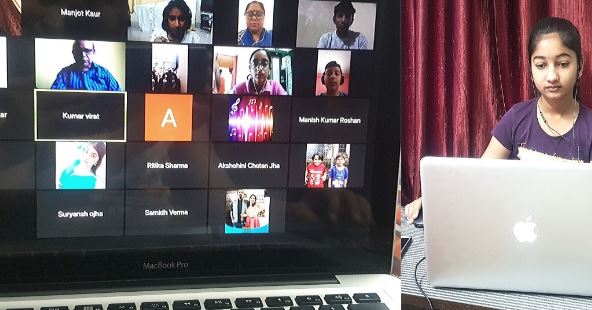
2. The use of Zoom and WhatsApp has been appreciated as they offer a live interactive environment where the children and the parents – also siblings and close family members see an arrangement to reach out to the children and arouse their involvement.
3. The structure of the home work has been personalized – (discussed by the teachers), exciting and flexible – (children encouraged to use the way they would like to support their understanding.)
We thus adopted options 2 and 3. There after we analysed the process on:
● Observations of the zoom interactions
● Homework compliance as evidenced by the children coming forward and using diverse methods like a slide by slide analysis
● Interaction between the teachers and the students and points and counterpoints by the peers from the same class.
● Parents too engaged inviting their observations and processing their of feedback.
Findings
1. There was wide appreciation of the virtual classes using zoom which offers opportunity for excitement and technological manoeuvring. This can be adopted even during the post lockdown period.
2. The excitement of virtual classrooms also rubbed on the older generation as we could observe the family members looking at what was going on and the parents/siblings adjusting the gadgets in a gesture of support. This, according to us, may prove precursor to family solidarity and parental cooperation/involvement. We could see one of the home works certified by the father – ‘home work done by so and so’. The younger siblings too showed a lot of interest. One of the students observed that the younger sibling was not bothering much as she had taken the role of mentoring her peer group.
3. Most important finding has been about the home work, which was designed to be creative, constructive and exciting by the respective teachers. Once could observe the orientation of a specific teacher through the home work s/he assigned and compliance received. Followings are important observations about the homework:
● The home work offers opportunity for transparency as they pass through everybody’s attention. Nobody can just glance through – it has the attention from others.
● The flexibility in completing home work was offering opportunity for envisioning, playing adult role and life that one may see beyond. One could see a child playing role of a master chef or acting as careful parent to the younger sibling.
● The sessions have entered the living rooms and kitchens of the students and we came across visuals where the real family situation was evident. Grandparents appreciating and approving the grand children of their work and activities was like icing on the cake.
● Technology was easy to handle and simple to demystify. This is a great opportunity for creating a future ready citizen.
● The children engaged through arguments, contested the views from the peers and the teachers and offered evidences culled out from the rich sources from wherever they could find. The pace of exploration too had a new direction and speed.
● Given the transparent environment of virtual accountability, the teachers have become extra-careful and working towards exciting and enthusing children under their charge. They too are experimenting and coming out with diversity of thoughts and views. Such innovations as using musical notes in recitation was found to be very refreshing. And the students did not disappoint and competed with each other to be diverse and innovative!
4. Over all, our learning is that the social distance did not prove to be a deterrent in encouraging creative and emotional flow. This was possible because of combined use of technology and empathy adopted by the school, the community and the students.
Implications and limitations
Our learning has limitation in being based on a very short period involving small number of children and community. This shows just an initial trend – much of which would depend upon how it evolves over time. We, as a school, see some pointers however:
❖ The combination of formats used has showed great potential for reaching a large number of children with quality inputs. This necessitates preparation by the teachers and the schools. The situation has led to a pedagogical innovation which has called for reorienting teachers, stressing on the need for attitudinal changes and change in their value system.
❖ In the current top down approach inclusive education may not be a reality. A principal, at the helm of affairs, passing orders and seeking compliance may not work well. Instead consultation, cooperation, collaboration would replace the existing system where the school leadership may need to be a catalyst and coordinator respecting and allowing adequate space for creativity, openness, flexibility and questioning. The children need to be taken as individuals with rich academic endowment.
❖ The schools may be seen as a place where teachers with diverse faculty would join together and evolve contents and creativity suiting to the evolving needs of the individual children. As has been indicated earlier, the teacher may need to challenge a student for diversities but at the same time should be willing to accept and respect their diverse views and be prepared for questioning.
❖ Looking at the growing role of technology the schools need to be future ready for technological innovation and adaptation and for that space for such persons may need to be adequately allowed
❖ Coming from the present learning, there could be a need for ‘redevelop’ the ‘school hours’. The children may be allowed to divide their time between the school and home working on the same assignment.
(The writer is Director, Manava Bharati International School, Patna. He acknowledges the contribution of the research team led by Professor Rajeshwar Mishra, the school principals and the teachers)