
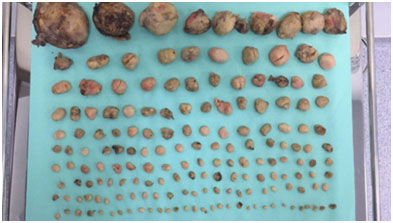
New Delhi: Very recently, as many as 191 benign tumours were removed from the uterus of an Omani woman at a private hospital in Kozhikode, north Kerala.
The complicated surgery took 4 long hours without removing the patient’s ovaries or uterus.Initially, the doctors thought of performing laparoscopic surgery,but later on when they discovered that the size of the tumour is really big they then blended the keyhole and used the traditional method to remove the tumours. The number of tumours removed is set to establish a world record.
The Uterus tumour among woman is very common most of them are overlooked upon as they are not easily detected because they give no or minimum symptoms initially.
There probably isn't a woman alive who doesn't feel a wave of terror when her doctor mentions the word tumor. A lot of women have uterine fibroids at some point in their life. You may have even had them and never known it. That’s because they often don’t cause any pain or symptoms that’s why when it's a fibroid tumor, experts say there is little to fear. Lets understand what are Uterus Tumour or Fibroids.
Uterine Fibroids:
Uterine fibroids are noncancerous growths of the uterus that often appear during childbearing years. Also called leiomyomas (lie-o-my-O-muhs) or myomas, uterine fibroids aren't associated with an increased risk of uterine cancer and almsost never develop into cancer.
Fibroids can vary a lot in size, shape, and location. They can show up in your uterus, uterine wall, or on its surface. They can also attach to your uterus by a stalk- or stem-like structure.
Some are so small that your doctor can’t even see them with the naked eye. Others grow in big masses that can affect the size and shape of the uterus.
Uterine fibroids usually appear in women of childbearing age -- generally between 30 and 40 years old, but they can show up at any age.
Uterine fibroids are benign tumors that originate in the uterus (womb). Although they are composed of the same smooth muscle fibers as the uterine wall (myometrium), they are much denser than normal myometrium. Uterine fibroids are usually round.
Uterine fibroids take place in the uterus of the woman, so let’s know more about the organ.
The uterus is a hollow organ in females located in the pelvis, commonly called the womb. The uterus functions to support fetal development until birth. The uterus is shaped like an upside-down pear; the top is the fundus, the middle is the corpus, and bottom is the cervix; the inner layer of the uterus is the endometrium, and the outer layer is muscle (myometrium).
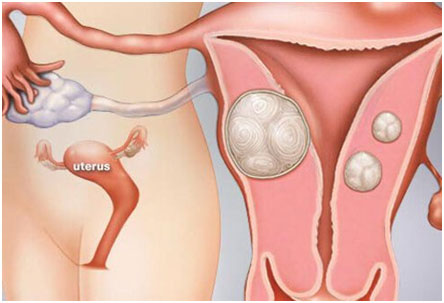
Fibroids range in size from seedlings, undetectable by the human eye, to bulky masses that can distort and enlarge the uterus. You can have a single fibroid or multiple ones. In extreme cases, multiple fibroids can expand the uterus so much that it reaches the rib cage.
Many women have uterine fibroids sometime during their lives. But most women don't know they have uterine fibroids because they often cause no symptoms. It may get discover incidentally during a pelvic exam or prenatal ultrasound.
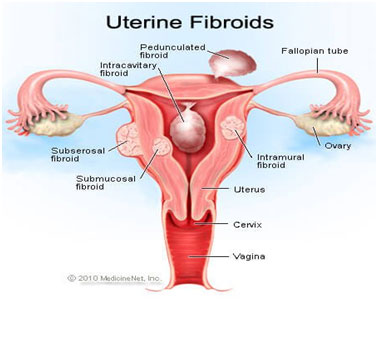
Types of Fibroids:
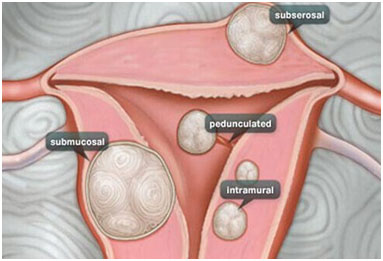
Different fibroids develop in different locations in and on the uterus.
Intramural Fibroids
Intramural fibroids are the most common type of fibroid. These types appear within the muscular wall of the uterus. Intramural fibroids may grow larger and can stretch your womb.
Subserosal Fibroids
Subserosal fibroids form on the outside of your uterus, which is called the serosa. They may grow large enough to make your womb appear bigger on one side.
Pedunculated Fibroids
When subserosal tumours develop a stem (a slender base that supports the tumour), they become pedunculated fibroids.
These types of tumours develop in the middle muscle layer (myometrium) of your uterus. Submucosal tumours are not as common as other types, but when they do develop, they may cause heavy menstrual bleeding and trouble conceiving.
Cause of Uterine Fibroids:
The cause of uterine fibroids is still unknown, it is still unclear why fibroids developbut research and clinical experience point to these factors and several factors may influence their formation:
Hormones
Estrogen and progesterone are the hormones produced by the ovaries. They cause the uterine lining to regenerate during each menstrual cycle and may stimulate the growth of fibroids.Fibroids contain more estrogen and progesterone receptors than normal uterine muscle cells do. Fibroids tend to shrink after menopause due to a decrease in hormone production.
Family History
Fibroids may run in the family. If your mother, sister, or grandmother has a history of this condition, you may develop it as well.
Pregnancy
Pregnancy increases the production of estrogen and progesterone in your body. Fibroids may develop and grow rapidly while you are pregnant.
Other growth factors
Substances that help the body maintain tissues, such as insulin-like growth factor, may affect fibroid growth.
According to Dr. Kanika Aggarwal, Gynaecologist, Delhi, “Uterine fibroids develop from a stem cell in the smooth muscular tissue of the uterus (myometrium). A single cell divides repeatedly, eventually creating a firm, rubbery mass distinct from nearby tissue.
The growth patterns of uterine fibroids vary — they may grow slowly or rapidly, or they may remain the same size. Some fibroids go through growth spurts, and some may shrink on their own. Many fibroids that have been present during pregnancy shrink or disappear after pregnancy, as the uterus goes back to a normal size.”
Symptoms of Fibroids:
Most women with fibroids (also known as leiomyomas) experience no symptoms. But for at least 25% of patients, some symptoms will occur. These may involve abdominal pressure, which can feel like fullness in the pelvic region or bloating in the pelvis or stomach. Large leiomyomas can enlarge the lower stomach area, sometimes giving the false appearance of pregnancy.
Uterine fibroids can also impact your monthly menstrual cycle. This can take various forms. Some experience mild to severe cramping and pain. Others will find their bleeding is heavier, and their heavy periods sometimes include blood clots. Others find their menstruation lasts longer or becomes more frequent. It can also cause spotting or bleeding in between menstruation.
Other potential symptoms of uterine fibroids include pain during sexual intercourse and lower back pain. Because the leiomyomas can press against the bladder, they may provoke frequent urination.
In women who have symptoms, the most common symptoms of uterine fibroids include:
• Heavy menstrual bleeding
• Menstrual periods lasting more than a week
• Pelvic pressure or pain
• Frequent urination
• Difficulty emptying the bladder
• Constipation
• Backache or leg pains
Rarely, a fibroid can cause acute pain when it outgrows its blood supply, and begins to die.
Is uterine fibroid a cancer?
Fibroid tumors are benign by definition. When a smooth muscle tumor is cancerous, it is called leiomyosarcoma and occurs only once in every 1,000 smooth muscle tumors of the uterus. This type of cancer is not believed to arise from benign fibroids. Your chances of developing a cancerous growth do not increase because you have uterine fibroids, nor does having them increase your chances of getting other uterine cancer.
Risk factors involved:
There are few known risk factors for uterine fibroids, other than being a woman of reproductive age. Other factors that can have an impact on fibroid development include:
• Heredity. If your mother or sister had fibroids, you're at increased risk of developing them.
• Race. Sometimes the race from which the woman belong do play a significant role. Black women are more likely to have fibroids than women of other racial groups. In addition, black women have fibroids at younger ages, and they're also likely to have more or larger fibroids.
• Environmental factors. Onset of menstruation at an early age; use of birth control; obesity; a vitamin D deficiency; having a diet higher in red meat and lower in green vegetables, fruit and dairy; and drinking alcohol, including beer, appear to increase your risk of developing fibroids.
Do untreated uterine fibroids pose a risk?
For the most part, uterine fibroids that do not cause a problem for the woman can be left untreated. In some cases, even fibroids that are not causing symptoms require removal or at least close observation. Rapid growth is a reason to watch more carefully, since a rare cancerous form of fibroid (referred to as a leiomyosarcoma) can be a fast-growing tumour, and it cannot be differentiated from a benign fibroid by ultrasound, MRI , or other imaging studies. However, this type of tumor occurs in less than 1% of uterine fibroids.
Another risk of leaving these tumors alone is that they sometimes grow to a size that eventually causes significant symptoms, thus requiring removal. If fibroids grow large enough, the surgery to remove them can become more difficult and risky.
What are the usual ways of diagnosing uterine fibroids?
According to Dr. Kanika, “Uterine fibroids are diagnosed by pelvic exam and even more commonly by ultrasound. Often, a pelvic mass cannot be determined to be a fibroid on pelvic exam alone, and ultrasound is very helpful in differentiating it from other conditions such as ovarian tumours. MRI and CT scans can also play a role in diagnosing fibroids, but ultrasound is the simplest, cheapest, and best technique for imaging the pelvis.”
“Occasionally, when trying to determine if a fibroid is present in the uterine cavity (endometrial cavity), a hysterosonogram (HSG) is done. In this procedure, an ultrasound exam is done while contrast fluid is injected into the uterus through the cervix. The fluid within the endometrial cavity can help outline any masses that are inside, such as submucosal fibroids,” she further added.
Can Fibroids be prevented?
Then the answer is No. There are few researches that suggest certain lifestyle habits can reduce the chances definitely.
One study found that high-sugar diets may be linked to a higher risk in some women. Another study found that eating fresh fruits and cruciferous vegetables like arugula, broccoli, cabbage, cauliflower, collard greens, and turnip greens could lower your odds. Cruciferous vegetables are rich in beta-carotene, folate, vitamins C, E, and K, and other minerals. They’re also full of fiber.
Regular exercise also can lower your chances of uterine fibroids.
References:
www.mayoclinic.org
www.medicinenet.com
www.onhealth.com
www.webmd.com
www.healthline.com
www.medicinenet.com