
New Delhi: Ordinary headaches are part of the normal human experience. We all get headaches every once in a while. However, a headache that is severe, persistent or associated with other symptoms such as vomiting and confusion is a warning signal to a dangerous problem.
While a headache may be brought on by something fairly simple such as dehydration or fatigue, it could also be a sign of a more serious illness. So, before just popping a few pills when you feel the onset of a headache or a migraine, take the time to notice your symptoms to make sure there isn’t something more serious going on.
Headache pain occurs either in the tissues covering the brain, attaching structures at the base of the brain, or Muscles and blood vessels around the scalp, face, and neck. Headaches can be categorised in Primary and Secondary Headaches:
A Primary Headache is one when a disease or other medical condition does not cause it. While, Secondary headaches are caused by other medical conditions, such as sinusitis infection, neck injuries or abnormalities, and stroke. About 2% of headaches are secondary headaches caused by abnormalities or infections in the nasal or sinus passages.
There are six main types of headaches – the most common ones – and each one can tell you a little something about your body. Knowing what type of headache you are experiencing can therefore allow you to treat it correctly.
Types of Headaches:
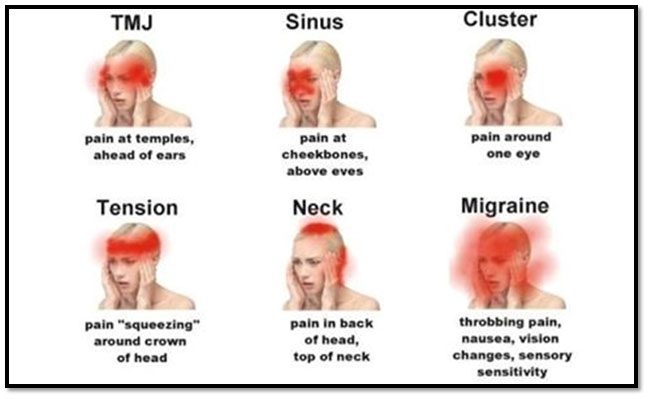
1. TMJ Headache:
There are dental-related conditions that can trigger headaches or face pain, such as bruxism and temporomandibular joint disorder (TMJ). Bruxism is grinding your teeth at night, while TMJ affects the joints, located just in front of your ear, which connect the jaw to the skull.
TMJ can be caused by bad jaw alignment, stress, poor posture (like sitting at a computer all day), or arthritis, which affect the cartilage, muscles, or ligaments in the jaw. TMJ pain can occur in the ear, cheek, temples, neck, or shoulders.
The diagnosis is easy if chewing produces pain or if jaw motion is restricted or noisy. Your dentist can help diagnose these types of headaches, and treatment includes stretching the jaw, hot or cold packs, stress reduction, and bite guards.
2. Sinus headaches:
People with migraines often mistake them for sinus headaches. (One study found that 88 percent of people with a history of sinus headaches probably had migraines instead.) Symptoms like sinus pressure, nasal congestion, and watery eyes can happen in both types.
A true sinus headache is related to an infection and comes with nasal discharge that is green or tinged with red, said doctors. Sinus infections often resolve with time or antibiotics, if necessary, and shouldn't cause nausea or light sensitivity, which are migraine symptoms.
How to treat it: Drink lots of fluids to hydrate your body. Warm water can help open your sinuses and reduce inflammation. Vitamin C is rich in antioxidants and can aid the body in fighting infections, so eat a few oranges or other foods rich in Vitamin C, or sip on some lemon green tea. You may also want to try a hot and cold compress, warm soup, and some fresh ginger, which contains anti-inflammatory and pain killing properties.
3. Cluster headache:
These one-sided headaches are short-lived (15 minutes to 3 hours), but excruciating. These are so painful they're sometimes called the suicide headache. Cluster headaches recur regularly, even multiple times daily, over a certain period of time and then may be followed by a headache-free period of months or even years.
There may be redness and tearing in one or both eyes. Cluster headache is more common in men than women. Triggers can include alcohol, cigarettes, high altitudes, and certain foods.
How to treat it: The active ingredient in capsaicin cream is cayenne pepper. Apply a small amount of this cream to your nostril where you are experiencing pain. It can help to block nerve pain signals.
4. Tension Headache:
Tension-type headache (also called muscle contraction headache) is the most common of all headaches. Tension-type headache is often experienced in the forehead, in the back of the head and neck, or in both regions.
It is commonly described as a tight feeling, which usually feels like a constant aching or pressure - rather than throbbing - on both sides of the head or at the back of the head and neck. Soreness in the shoulders or neck is common in this type of headache.
Triggers can include stress, anxiety, bad posture, and clenching your jaw, and these headaches can become chronic, although they usually aren't severe. Experts aren't sure of exact cause, although it may be due to altered brain chemicals or mixed signals in the nerves leading to the brain.
Sufferers of tension-type headaches are more sensitive to light than the general population, even between attacks. They also may suffer from visual disturbances. Tension-type headaches can last minutes to days.
How to treat it: Ginger tea can help to reduce inflammation, and adding peppermint oil to your hairline can create a cooling sensation to relax the muscles in your head and neck. Combining these two natural remedies will help to eliminate the pain of a tension headache.
5. Neck Headache:
Cervicogenic Headache is a secondary headache disorder. In other words, your headache is caused by a neck joint problem. The good news is that by fixing your neck problem, your neck headache can be alleviated.
Researchers feel that neck headache accounts for 4% to 22% of all headaches, seen clinically. Your neck headache can originate from a variety of musculoskeletal and neurovascular structures in your upper neck; including the upper three neck joints, C2/3 disc, spinal cord coverings and neck muscles.
A dysfunction in these areas can trigger pain signals that travel to your brainstem. This information is then transmitted into your brain and interpreted as a neck headache. However, Skilled Osteopaths and Chiropractors can release locked joints and relieve these headaches almost instantly.
6. Migraine
Migraine is now recognized as a chronic illness, not simply as a headache. One common migraine trigger is change, including hormones, stress, and sleeping or eating patterns.
If you know skipping meals is a trigger, don't skip meals while menstruating and having a late night, said doctors.
In general, there are four symptom phases to a migraine (although they may not all occur in every patient):
The prodrome- The prodrome phase is a group of vague symptoms that may precede a migraine attack by several hours, or even a day or two. Such prodrome symptoms can include sensitivity to light or sound, changes in appetite, fatigue and yawning, malaise and mood changes.
Auras- Auras are sensory disturbances that occur before the migraine attack occurs. Patients may have mixed positive and negative auras. Positive auras include bright or shimmering light or shapes at the edge of their field of vision called scintillating scotoma. Other positive aura experiences are zigzag lines or stars. Negative auras are dark holes, blind spots, or tunnel vision (inability to see to the side). If untreated, attacks usually last from 4 to 72 hours. A typical migraine attack produces throbbing pain on one side of the head, but it can be bilateral.
The attack- But the word migraine is derived from the Greek word hemikrania, meaning “half of the head” because the pain of migraine often occurs on one side. Pain also sometimes spreads to affect the entire head.
The postdrome phase- After a migraine attack, there is usually a postdrome phase, in which patients may feel exhausted and mentally foggy for a while.
How to treat it: Vitamin B12 (riboflavin) has been shown to help those who suffer from migraines, as have magnesium and omega-3 fatty acids. Make sure you are getting enough of these in your diet on a daily basis to help prevent migraine attacks. A 2011 study also found that aerobic exercise was as effective at preventing migraines as the preventative migraine medication topiramate, concluding that daily exercise may be used as a replacement for medication.
References:
https://www.cbsnews.com
http://realfarmacy.com
https://www.davidwolfe.com
https://forum.facmedicine.com/
https://www.davidwolfe.com