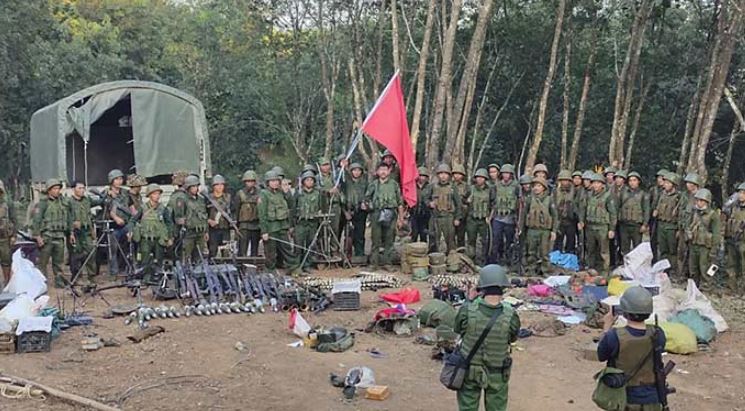
A rapidly expanding offensive by Myanmar’s anti-junta groups has seen resistance fighters capture key towns and regions near the border with India in recent days, fuelling concerns on Tuesday about a spillover of tensions and influx of refugees to the northeastern states.
The offensive by three powerful anti-junta groups, named “Operation 1027” after the date it started last month, initially focused on Myanmar’s northeastern Shan state that borders China. Successes by resistance fighters in Shan, including the capture of towns and more than 100 military outposts, were followed by similar attacks in Chin state and Sagaing region, which both border India.
A group of about 80 rebels took control of Rihkhawdar and Khawmawi military camps in Chin state on Monday after several hours of fighting. Rihkhawdar, located a short distance from Zokhawthar town in Mizoram, is home to one of only two official land border crossing points between India and Myanmar.
In Sagaing region, rebel groups claim to have captured Khampat, a key town located a little more than 50km from the second official border crossing point between Tamu in Myanmar and Moreh in Manipur. Intense fighting has also been reported in recent days from Myanmar’s Rakhine state, where rebels have seized military posts in Rathedaung and Minbya towns.
The fighting in Rihkhawdar resulted in some 5,000 Myanmarese nationals, including more than 40 soldiers, seeking shelter in Mizoram since Sunday. People familiar with the matter said on condition of anonymity that concerns are growing about more people from Myanmar crossing porous borders to seek refuge in India’s northeast, and the tensions spilling over to the Indian side following air strikes by Myanmar’s military.
The fighting in the north — which the United Nations says has displaced more than 50,000 civilians — has sparked the most significant military challenge to the junta since it seized power in 2021 after deposing the democratically elected government of Nobel laureate Aung San Suu Kyi, analysts say.
The upsurge in fighting in Myanmar may also have implications for the Meitei-Kuki clashes in Manipur. Myanmar’s Chin ethnic group has close ties with Kukis and there have been reports of Chin rebels aiding Kukis in recent months. Several Meitei militant groups from Manipur have a presence in Sagaing Region and are believed to enjoy the support of Myanmar’s military.
There was no response from Indian officials on the developments.
The people cited above said the Indian side is closely monitoring the situation and will take steps to protect security concerns in the northeastern states. They said contacts were ongoing with Myanmar’s military leadership to assess the situation.
Toe Kyaw Hlaing, a councillor of the National Unity Consultative Council (NUCC), an advisory body to Myanmar’s government in exile, described Operation 1027 as the first wave of an acceleration of military operations by resistance groups. “It was followed by Operation 1111 in Karenni State and Operation 1113 in Rakhine, upper Sagaing and Chin. It is a very well-coordinated offensive,” he told HT.
Hlaing said the resistance groups’ fight against what he described as the “terrorist army”, which started in September 2021, had moved from a defensive phase to a counteroffensive aimed at occupying key areas. “As part of the second stage of this counteroffensive, nationwide operations have been launched,” he said.
He contended the resistance forces now control about 70% of Chin state and are making gains in areas such as Sagaing region. “On Monday, the fighters occupied Rihkhawdar, which is a key commercial post between Chin state and India,” he said.
More than 120 soldiers from Infantry Battalion 129 surrendered in Shan state, while police personnel laid down arms in Rakhine state, he said.
The successes of the resistance fighters prompted Myanmar’s military to launch air strikes in Sagaing region and Chin and Karenni states, Hlaing said. “The military is targeting civilians for not supporting them, and they have purposely invented a humanitarian crisis to hinder the revolution,” he said.
The air strikes are against international law and adding to the two million people already displaced by the fighting, Hlaing said. The resistance fighters are trying to minimise casualties, he said, pointing out that civilians were moved out of Khampat before clearing operations.
The claims of the resistance groups couldn’t be independently verified, though experts said Myanmar’s junta is currently facing its greatest challenge since assuming power in a coup in February 2021. Videos have emerged of air strikes in Rihkhawdar, sparking concerns among residents on the Indian side.
Angshuman Choudhury, an associate fellow at the Centre for Policy Research (CPR) who closely tracks developments in Myanmar, said ongoing offensives by resistance groups have direct implications for India because large swathes of territory along the border have been captured by these forces.
“Myanmar’s military regime is facing unprecedented stress along multiple fronts. It has lost several bases, soldiers and hardware since Operation 1027 began and is struggling hard to respond,” Choudhury said. “It is high time that New Delhi looks beyond its narrow relationship with the junta and starts seriously engaging with the pro-democracy groups fighting on the ground and the National Unity Government (NUG) that is coordinating the overall pro-democracy political strategy across Myanmar.”
India has maintained ties with Myanmar’s military regime largely because of concerns about the activities of anti-India militant groups, which have several bases across the border. In the past, the armies of the two countries have conducted coordinated operations against these groups but the focus of Myanmar’s military had shifted following the coup.
Hlaing said Myanmar’s pro-democracy forces want the Indian government to “stop its relationship with the State Administration Council (SAC)”, which has ruled the country since the coup of 2021.
“We want India to stop supporting the SAC with military equipment or technical assistance in return for sham elections, and to communicate more with key revolutionary stakeholders such as NUCC, NUG, Committee Representing Pyidaungsu Hluttaw (CRPH) and ethnic resistance organisations, which represent the voice of the people of Myanmar,” he said.
(With inputs from agencies)