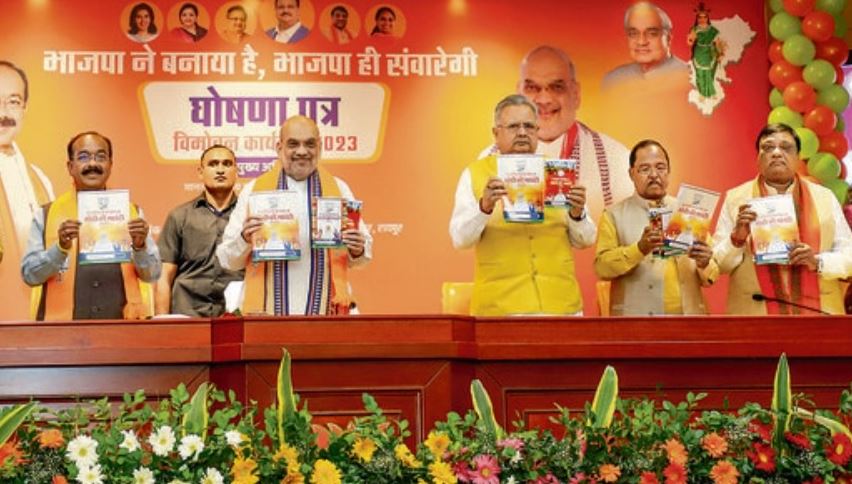
The Bharatiya Janata Party (BJP) is not opposed to a caste census but contesting polls using this plank is not correct, Union home minister Amit Shah said on Friday, articulating his party’s stand on a major electoral issue in the five-state assembly polls this month.
While launching the BJP’s manifesto in Raipur, Chhattisgarh, Shah decried attempts by Opposition parties to politicise the issue, a reference to the Congress that has promised to hold caste-based surveys in four mainland poll-bound states if it comes to power.
He also announced, as part of the BJP’s poll manifesto, a slew of promises aimed at farmers and women, two key demographics that can shape the assembly elections. This included an annual assistance of ₹12,000 to married women and ₹10,000 to landless farm labourers, procuring 21 quintals of paddy per acre at ₹3,100 and providing LPG cylinders for ₹500.
“We don’t seek vote on this issue [caste census] since we are a national political party. We will discuss with everyone and whatever will be appropriate we will declare, but to fight elections on this issue is not correct...,” he said. “The BJP never opposed it [caste census] but decisions have to be taken after proper thought and we will tell at appropriate time,” he added.
His comments mark the strongest response by the BJP to the Opposition’s demand for a caste census since Prime Minister Narendra Modi said that poor were the biggest caste for him, and accused the Opposition of dividing society.
It came amid promises by the Congress to hold caste-based surveys in Rajasthan, Chhattisgarh, Madhya Pradesh and Telangana if it wins the upcoming assembly polls in these states. The Congress has sought to make the caste census a core poll plank and the Indian National Developmental Inclusive Alliance of 28 opposition parties has included it in its key agenda.
Congress leader Rahul Gandhi had repeatedly called for a national caste census in his election rallies, seeking to portray the demand as one that will benefit other backward classes (OBCs), a key vote bank. In numerous rallies over the past three weeks, Gandhi has argued in favour of a caste census, saying that it will aid in understanding the country’s demographic composition and pave the way for an inclusive development strategy.
On October 2, Bihar released the results of its landmark caste survey that revealed that backward communities comprised nearly two-thirds of the state’s population and general categories formed around 15.5%. The exercise — the first to successfully enumerate caste groups in independent India — was hailed by Opposition parties, prompting Gandhi to say, “Jitni aabadi utna haq” (Population weight will determine rights).
A day later, Modi hit back. At a rally in Chhattisgarh, the Prime Minister accused the Congress of trying to divide society through its call of apportioning resources proportional to the demographic weight of communities, and asked if it was advocating for curtailing the rights of minorities.
“The Congress wants to destroy India by dividing the Hindus at any cost; it wants to divide the poor also. For me, the poor are the biggest caste in the country. If the poor are looked after well, the country will automatically be well,” the PM said.
The controversial caste survey, Opposition politicians hope, can precipitate a second Mandal moment, a reference to the implementation of reservation for OBCs in 1990 that coalesced OBCs into a potent electoral bloc and sparked the rise of a clutch of regional parties that changed the face of heartland politics.
The Indian National Developmental Inclusive Alliance, or INDIA, has also pushed for a nationwide caste census, hoping that just as the first Mandal movement countered the Ram Janmabhoomi movement and helped regional parties craft alliances to hold on to power for nearly two decades, a second similar churn could pose a challenge to the dominant BJP, and fracture its rainbow Hindu coalition, especially among marginalised castes.
The BJP’s stance on the Bihar caste exercise has been cautious. The party believes that its dominance is built on a successful strategy to mobilise less-dominant backward and Dalit groups into a broader Hindu umbrella. The party has also injected marginalised caste leaders into its ranks, effectively countering an earlier perception that it was primarily focused on its traditional vote base, the upper castes.
At an election rally in Pandariya later in the day, Shah attacked the Congress and said that religious conversion was on the rise. He also accused the Congress of indulging in scams and said if the BJP was voted to power in the state, all corrupt people will be sent to jail.
He dubbed Chhattisgarh chief minister Bhupesh Baghel as a “prepaid CM” of the Congress, accusing him of turning the state exchequer into an ATM of the opposition party.
“In the Congress rule, religious conversion is on the rise. The Constitution gives liberty to every citizen to follow the faith of their choice. But they have started using the state machinery to convert poor tribals, which is not in the interest of the state. As a result of it, clashes have erupted in every house and village of the state, and the law and order has deteriorated,” he said.
The BJP is attempting to dislodge the Congress in Chhattisgarh.
Reacting to Shah’s comments, Baghel said that the BJP manifesto did not talk about farmers’ loan waiver and Old Pension Scheme (OPS), while accusing the party of “copying” the Congress guarantees.
“They (BJP) copied Congress’ guarantees. They didn’t talk about (farmers’) loan waiver, didn’t talk about OPS, and the Central government stopped the bonus. Now will they take it back?” Baghel told ANI.
On Shah’s statement of investigating the cases of alleged corruption in the state if voted to power, CM Baghel said, “They should first (arrest) Raman Singh. (Raman Singh’s) Son Abhishek Singh’s name is there in the Panama case... If you do selective work, people will not like it.”
(With inputs from agencies)