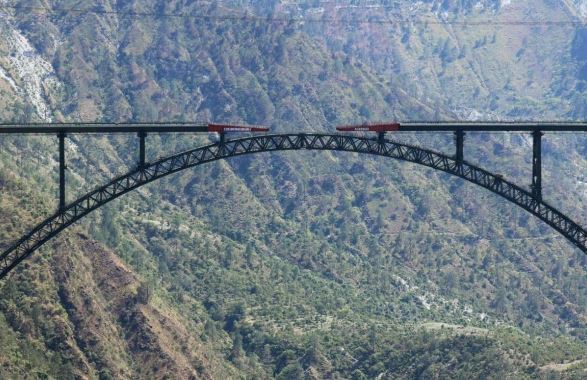
In a big milestone, the overarch deck of the iconic Chenab Railway Bridge in Jammu and Kashmir, which is world’s highest railway bridge, will get completed with a golden joint this month, pushing the project to 98 per cent completion.The final piece of the overarch deck at the world’s highest single-arch railway bridge is expected launch on August 13. The moment will be marked with a golden joint.The bridge superstructure on the arch was incrementally being pushed from two ends of the Chenab River valley, and it will finally meet at the middle of the arch.
Giridhar Rajagopalan, Deputy Managing Director of Afcons, said that the reason it is called golden joint is the intricacies in the coordinates to make sure it fitst perfectly.
“Once the golden joint is completed, we can safely say that the bridge is about 98% complete,” said Giridhar Rajagopalan.
An iconic bridge that involved complex engineering, Chenab Bridge faced multiple obstacles. Starting from the geology, the terrain and the hostile climate, the engineers and railway officials have faced it all to reach this moment.“When we finished the arch closure last year, it gave us huge relief in terms of our competency to finish the project with such accuracy that there was no mismatch. And that gave us a lot of confidence to tackle the balance part of the project very comfortably. Together with NR and KRCL, we are eagerly looking forward to the forthcoming milestone of the golden joint,” Giridhar added.There are plenty of firsts in the construction of the world’s highest railway bridge, and once completed, it will stand 35m higher than the Eiffel Tower. Besides the Chenab Bridge, Afcons is also constructing 16 other railway bridges for Konkan Railway Corporation Limited (KRCL) in the hostile terrains of Jammu and Kashmir. All the bridges are part of the Udhampur Srinagar Baramulla Rail Link (USBRL) project.
Afcons recently completed the main deck slab concreting of a bridge in the 16 KRCL bridges project that is even higher than the Qutub Minar. Around 1,550 cubic metres of concreting was done across four stages within 70 days. The entire activity took place at a height over 90m from ground level in the hilly terrain of Sangaldan, in Jammu and Kashmir.
(With inputs from agencies)