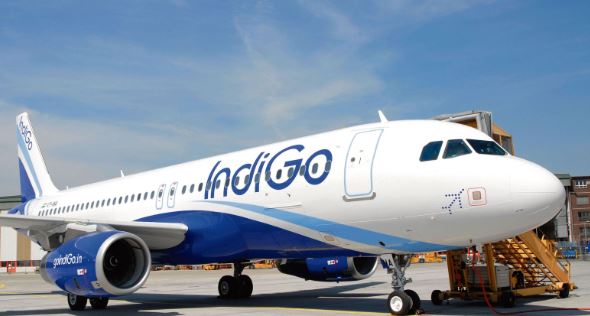
India’s aviation regulator, the Directorate General of Civil Aviation (DGCA), has released its data for May, revealing IndiGo’s continued dominance over the country’s domestic market. While other airlines dwarf in comparison to IndiGo’s share, they, too, have gained market share, primarily because of the gap left behind by Go First’s grounding.
IndiGo’s control over the Indian aviation market received a further boost in May, with the DGCA revealing the carrier’s market share to be 61.4%. The airline has long been commanding more than half of the domestic sector and was swiftly chasing its next milestone – the 60% mark. Its share in April was 57.5%.
Such is IndiGo’s position within the aviation space that not only do other airlines come nowhere close to it, but none of them are even in double digits. IndiGo’s closest competitor is Air India, with a 9.4% market share. The carrier itself saw an increase in its share compared to April, when it had an 8.6% market share.
Barring Go First and SpiceJet, all other national-level airlines saw an increase in their market position. Vistara was at the third position with a share of 9%, AirAsia India was fourth with a share of 7.9%, followed by SpiceJet, Akasa Air, and Go First with 5.4%, 4.8%, and 0.4%, respectively.
Not even a year old, India’s newest national-level airline Akasa Air is making impressive inroads into the country. While IndiGo’s gigantic market share grabs the spotlight and outshines all other airlines, Akasa Air’s performance can be considered quite impressive when examined in isolation.
The budget carrier will complete one full year of operations in August but is already approaching the 5% mark in market share. This is quite impressive, given that SpiceJet has been operating for years and is just a few points ahead of Akasa at 5.4%. However, SpiceJet’s share is expected to increase as it plans to expand its fleet size in the coming months.
But Akasa’s performance continues to impress beyond its market share. In May, it was the most punctual airline in India, with an on-time performance (OTP) of 92.6. IndiGo was a close second at 90.3, while Vistara grabbed the third spot with an OTP of 89.5.
The significant gains in market share in May for airlines such as IndiGo and Air India are primarily because of the space created by Go First’s absence. In many destinations in the country, for example, Pune, IndiGo completely dominates the departure and arrival boards at airports.
While IndiGo and the Tata Group airlines already dominated more than 80% of the Indian market, Go First’s grounding has widened the gap, with both blocks now approaching the 90% mark at almost 88%.
In recent days, both IndiGo and Air India have increased flight frequencies on several of Go First’s popular routes, such as Delhi to Leh, Srinagar, and Pune, and Mumbai to Leh, Srinagar, and Dehradun. With no official statement regarding Go First’s return, one could expect similar figures in the coming months as well.
(With inputs from agencies)