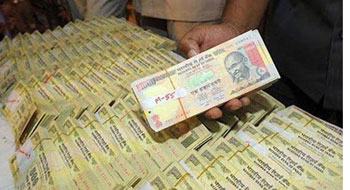
New Delhi: The Centre has rejected the Supreme Court`s directive to consider providing another chance to those who have not been able to deposit demonetised Rs.500 and Rs. 1000 notes by saying that it will “defeat the very object of demonetisation and elimination of black money”.
The Supreme Court had asked the Centre a fortnight back to consider granting a window to those who have not been able to deposit demonetised Rs 500 and Rs 1,000 notes due to “genuine reasons”.
“If a window is opened for further period, persons who are in possession of the Specified Bank Notes (SBNs) would have had sufficient time and opportunity to carefully plan the reasons and excuses for not depositing the SBNs within the permitted period which was till December 30, 2016,” the Union Finance Ministry said in an additional affidavit filed in the Supreme Court on Monday.
“Any number of benami transactions and user proxies for the purpose of producing and depositing SBNs would then arise… the departments would have great difficulty in deciding any genuine case from the numerous bogus ones,” said the document, which includes a detailed list of the various “malpractices” that came to light post-demonetisation.
The affidavit was filed in response to a query from the court earlier this month. The court, on July 4, gave the Centre and Reserve Bank of India two weeks time to consider granting a window for “genuine reasons”.
“You (Centre) cannot be allowed to deprive a person of his money if he couldn’t deposit it due to some genuine problems. Consider giving a window to a genuine problem. What if someone is terminally ill and couldn’t deposit the money,” a bench of Chief Justice of India Justice J S Khehar and Justice D Y Chandrachud had said.
The court was hearing petitions challenging the government’s notification which disallowed people from depositing old notes after a prescribed time.
In its affidavit, the Finance Ministry said that a window of 51 days, barring closed bank holidays, was provided for exchanging old currency. Unlike in 1978, when there were only six days.
During this time, anyone could have deposited the notes in their possession, either in person or through their authorised agents, said the government, citing clause 2 of the November 8 notification which permitted deposit of the SBNs through third-party authorisation. The petitioner had not given a valid ground on why the notes could not be deposited through an authorised person during this time, it added.