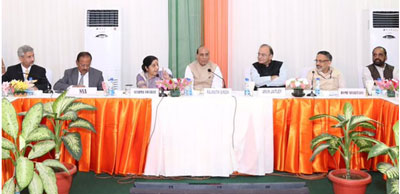
New Delhi: The government and major opposition parties have reached at a consensus on the need for India and China to pursue diplomatic options to resolve the Doklam standoff.
They also supported the action of Indian troops in stalling Chinese attempt to build a road through Bhutanese territory.
Opposition leaders were supportive of the Indian position that China has violated the commitments arrived at through the special representatives' dialogue, with Samajwadi Party patriarch Mulayam Singh Yadav, a former defence minister, saying China betrayed Nehru and would behave similarly with the NDA government if it let its guard down.
NCP leader Sharad Pawar, also a former defence minister, said India could borrow a leaf from China's book and be patient in resolving the face-off without resorting to hasty actions. While the opposition leaders supported India's stand, CPM leader Sitaram Yechury asked the government to "introspect" whether its policies on the Dalai Lama and military exercises with the US and Japan had contributed to the tensions.
The meeting also saw a discussion on the attack on Amarnath yatris and the situation in the Kashmir Valley with some opposition leaders like Congress' Ghulam Nabi Azad and Yechury suggesting the government open dialogue with stake-holders. Azad also said actions of gaurakshaks need to be checked by the Centre and states.
Home minister Rajnath Singh, who hosted the meeting, said he had not ruled out talks with any party in J&K. Opposition leaders appreciated home minister Rajnath Singh's Kashmiriyat comment on the Amarnath incident and felt that all-around condemnation of the attack can provide the setting for talks in the state.
The interaction saw foreign secretary S Jaishankar explaining that the Chinese claim to the territory near the Sikkim-Tibet-Bhutan tri-junction and its invocation of the 1890 Britain-China agreement is misleading. He quoted from a letter written by Jawaharlal Nehru in 1959 to belie the Chinese claim that India's first PM had accepted the 1890 treaty over Sikkim approving Beijing's claim on the Doklam area.
The government, represented by external affairs minister Sushma Swaraj and finance minister Arun Jaitley besides Singh, pointed out that India had been forced to respond to unilateral actions and was acting with restraint. It was explained that it was necessary to halt the Chinese advance as it would have seriously threatened India's strategic interests at the tri-junction and the road link between West Bengal and Assam.