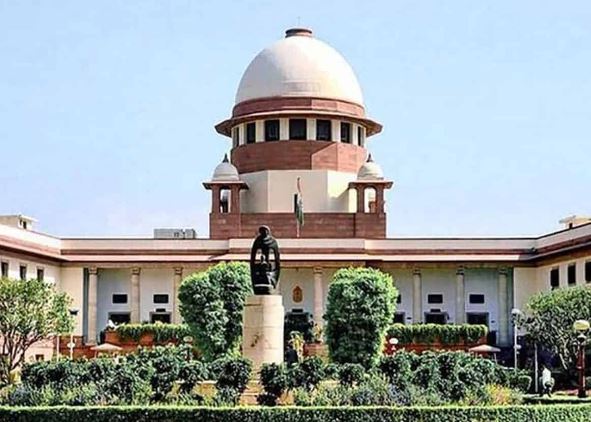
Article 370 cannot be said to have assumed the state of permanence in the constitutional fabric, the Supreme Court observed on Thursday, as it disagreed with an argument raised by petitioners who have challenged the 2019 abrogation of the provision that granted the region special status and the restructuring of Jammu & Kashmir into two Union territories.
According to a bench led by Chief Justice of India Dhananjaya Y Chandrachud, the issuance of constitutional orders between 1957 and 2019 go on to show that Article 370 was in force and so was the specific clause under the constitutional provision that empowered the President to make Article 370 cease to exist on the fulfilment of certain conditions.
The bench, which also comprised justices Sanjay Kishan Kaul, Sanjiv Khanna, Bhushan R Gavai and Surya Kant, remarked that the provision on abrogating Article 370 cannot be singularly held to be non-existent after the Constituent Assembly of J&K dissolved in January 1957 when other parts of Article 370 remained operational for the subsequent 62 years.
"It will not be correct to postulate that Article 370 achieved its life and what is a temporary provision assumes the state of permanence in the Indian constitutional fabric...Because then there was no question of any constitutional orders progressively being issued since 1957 onwards. If Article 370 has worked itself out and achieved its purpose once the Constituent Assembly completed its task, then where was the occasion to issue the constitutional orders?” the bench asked senior counsel Dushyant Dave, who was appearing for one of the petitioners, Rifat Ara Butt.
Dave, in the course of his arguments, sought to buttress the point that after the Constituent Assembly of J&K decided to continue with Article 370 instead of ending the special status of the erstwhile state, the provision cannot be abrogated by any subsequent act of Parliament or President. He added that the proviso to Article 370 (3) cannot be invoked now to nullify the provision since the article achieved its purpose and lived its life.
But the bench remained unimpressed. “Your whole argument is that Article 370 has worked itself out once the Constituent Assembly completed its task in 1957. But that would be belied in the least by the constitutional practice because there were constitutional orders issued progressively modifying the provisions of the Constitution as applicable to J&K...which means, really speaking, Article 370 had continued to operate even thereafter,” it retorted.
The bench pointed out that if Dave’s submission were to be accepted, there were no powers left to amend the J&K Constitution after 1957 by applying the provisions of the Indian Constitution to it because the authority to do so was available only under Article 370.
“There is an internal inconsistency in this submission because the consequence would be that there could be no amendment to J&K Constitution at all under 370 (2) after the Constituent Assembly completed its task in 1957. And this is belied not merely by the constitutional practice but also by acceptance by both the state of J&K and the Government of India that amendments were made even after 1957, and until the disputed amendment of 2019,” it said.
At one point, Dave called the issuance of constitutional orders “wrong practice” that perpetuated for six decades but the court did not find favour with his views.
“What are you talking about? We are talking about a practice over 64 years. If the power under proviso to clause 3 of Article 370 (on abrogation) has exhausted itself, then equally the power under the proviso to 370(1)(d) (on applying provisions of Indian Constitution to J&K) has also exhausted itself; in which case how do we explain the exercise of powers for the last 64 years? Therefore, if 370 (1) continues to exist it will be very difficult to argue that 370 (3) ceases to exist,” it told Dave, adding there must be a logical consistency in the apex court interpreting a constitutional provision.
Dave concluded his arguments on the seventh day of the hearing, submitting that the nullification of Article 370 in August 2019 was a fraud on the Constitution and that the only way open for the Centre to abrogate Article 370 was to amend the Constitution after securing a two-thirds majority in both houses of Parliament and the concurrence of state legislatures. The arguments in the case will resume on August 22.
Senior counsel Shekhar Naphade, representing academic and author Radha Kumar, argued that the concurrence of the Constituent Assembly cannot be equated with the opinion of the J&K legislative assembly for the purposes of abrogating Article 370 and therefore, the presidential proclamation and assumption of the power of J&K legislative assembly to nullify the provision was impermissible. Naphade also concluded his submissions on Thursday.
A raft of petitions, filed by parliamentarians from the National Conference party, Kashmiri citizens, former bureaucrats and various organisations laid the challenge to the abrogation of Article 370 soon after the presidential order in August 2019.
While some petitioners brought up the requirement of consent from the Constituent Assembly for the abrogation of Article 370, others questioned the validity of President’s Rule that was in effect when the abrogation was done. A few of these pleas went back to the Instrument of Accession, while some highlighted the Supreme Court’s ruling of 2018 that observed that Article 370 had gained a status of permanence. Many of these pleas also challenged the Jammu & Kashmir State Reorganisation Act, by which the state was bifurcated into two Union territories with effect from October 30, 2019.
(With inputs from agencies)